Design
Classical, Modern or Italian: Choosing a Furniture Style That Lasts
The three styles Pakistani homes actually choose between, what each one demands from a room, and how to mix them without the result looking accidental.
By Chiniot Furniture Galleria · · 2 min read
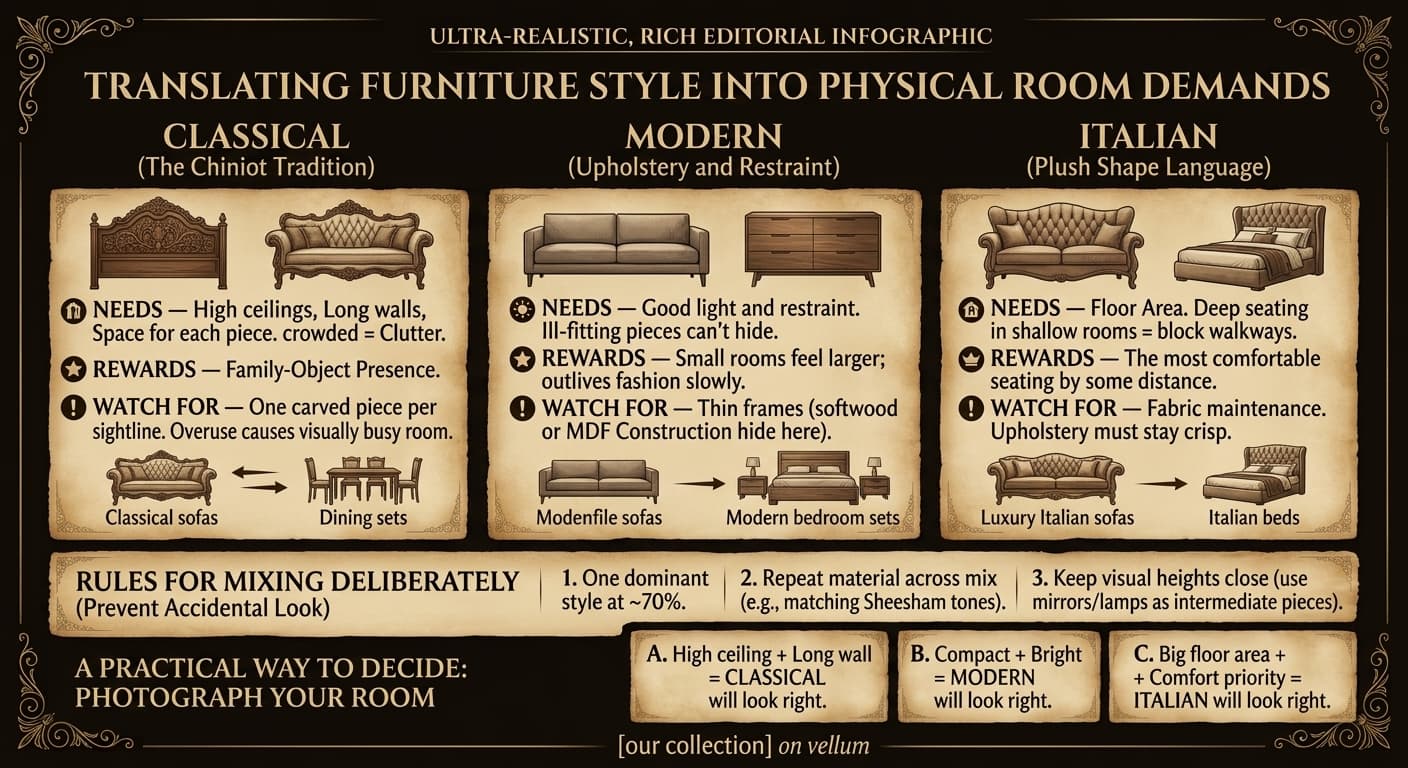
Style arguments usually end badly because they are conducted in adjectives. It helps to translate them into what each style physically demands: ceiling height, wall length, light, and how much visual noise the room can absorb.
Classical
Carved show-wood frames, deep naqashi panels, brass or bone inlay, generous proportions. This is the Chiniot tradition and the style most Pakistani drawing rooms are built around.
- Needs — high ceilings, long walls, and space around each piece. Carving crowded against a wall
reads as clutter.
- Rewards — presence, and a piece that becomes a family object rather than a purchase.
- Watch for — one carved piece per sightline. Two facing carved sofas plus a carved console
plus a carved table is a room that never rests.
Start with the classical sofas and classical dining sets.
Modern
Clean frames, low profiles, fluting or plain show-wood instead of relief carving, upholstery doing the visual work.
- Needs — good light and restraint. A modern room lives on proportion, so an ill-fitting piece
has nothing to hide behind.
- Rewards — small rooms feel larger; the furniture ages out of fashion slowly because there is
little fashion in it.
- Watch for — thin frames. Modern styling is often where softwood and MDF construction hides,
because there is no carving to demand solid timber.
See the modern sofas and modern bedroom sets.
Italian
The plush end: deep seats, curved or wingback silhouettes, heavier upholstery, restrained show-wood. Not a country of origin so much as a shape language.
- Needs — floor area. Italian seating is deep, and a deep sofa in a shallow room eats the
walkway.
- Rewards — the most comfortable seating of the three, by some distance.
- Watch for — fabric maintenance. The look depends on the upholstery staying crisp, so plan for
washable covers.
Browse the luxury Italian sofas and Italian beds.
Mixing them without it looking accidental
Mixing works when it is deliberate. Three rules carry most of it:
- One dominant style per room, at roughly 70 percent. The other style is an accent, not a
co-star.
- Repeat a material across the mix. A modern sofa and a classical console belong together when
both show the same Sheesham tone.
- Keep the visual heights close. A low modern sofa next to a tall carved cabinet needs
something in between — a mirror, a lamp pair, a plant — or the room looks unfinished.
The pieces that date fastest are the ones that were fashionable rather than proportionate. Buy proportion, and style stays a decision you can revisit with paint and textiles.
A practical way to decide
Photograph your room. Look at the ceiling height, the length of the longest wall, and how much daylight arrives after 3 pm. High ceiling and a long wall: classical will look right. Compact and bright: modern. Big floor area and comfort is the priority: Italian. The room usually answers before the catalogue does.
Frequently asked
- How do I choose between classical and modern furniture?
- Let the room decide. Classical carving needs high ceilings, long walls and space around each piece; modern styling suits compact, bright rooms because it lives on proportion rather than ornament.
- Can I mix classical and modern furniture in one room?
- Yes, if it is deliberate. Keep one style dominant at about 70 percent of the room, repeat a material such as a single Sheesham tone across both, and avoid large gaps in visual height between adjacent pieces.
- Which furniture style lasts longest before looking dated?
- Pieces chosen for proportion rather than fashion age slowest. Classical carving and plain modern frames both hold up well; heavily trend-driven silhouettes and finishes are what date a room.
Keep reading

Buying Furniture Online in Pakistan: A Safe Ordering Checklist
How to judge a furniture seller you cannot visit — the questions to ask, the specifications to demand in writing, and the delivery details to settle before you commit.
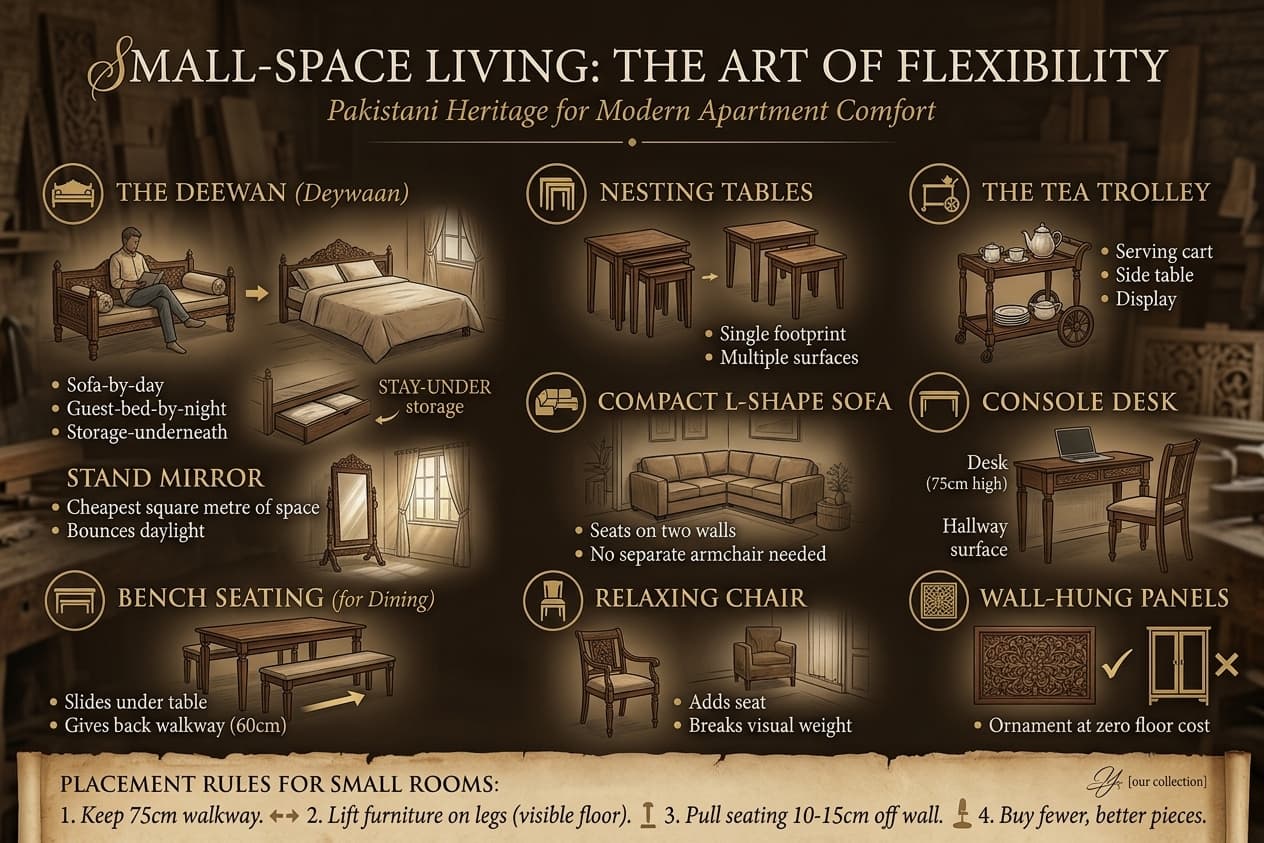
Furnishing a Small Apartment: Nine Pieces That Do Two Jobs
Nesting tables, deewans, tea trolleys and stand mirrors — the traditional pieces that solve modern apartment problems, and how to place them.
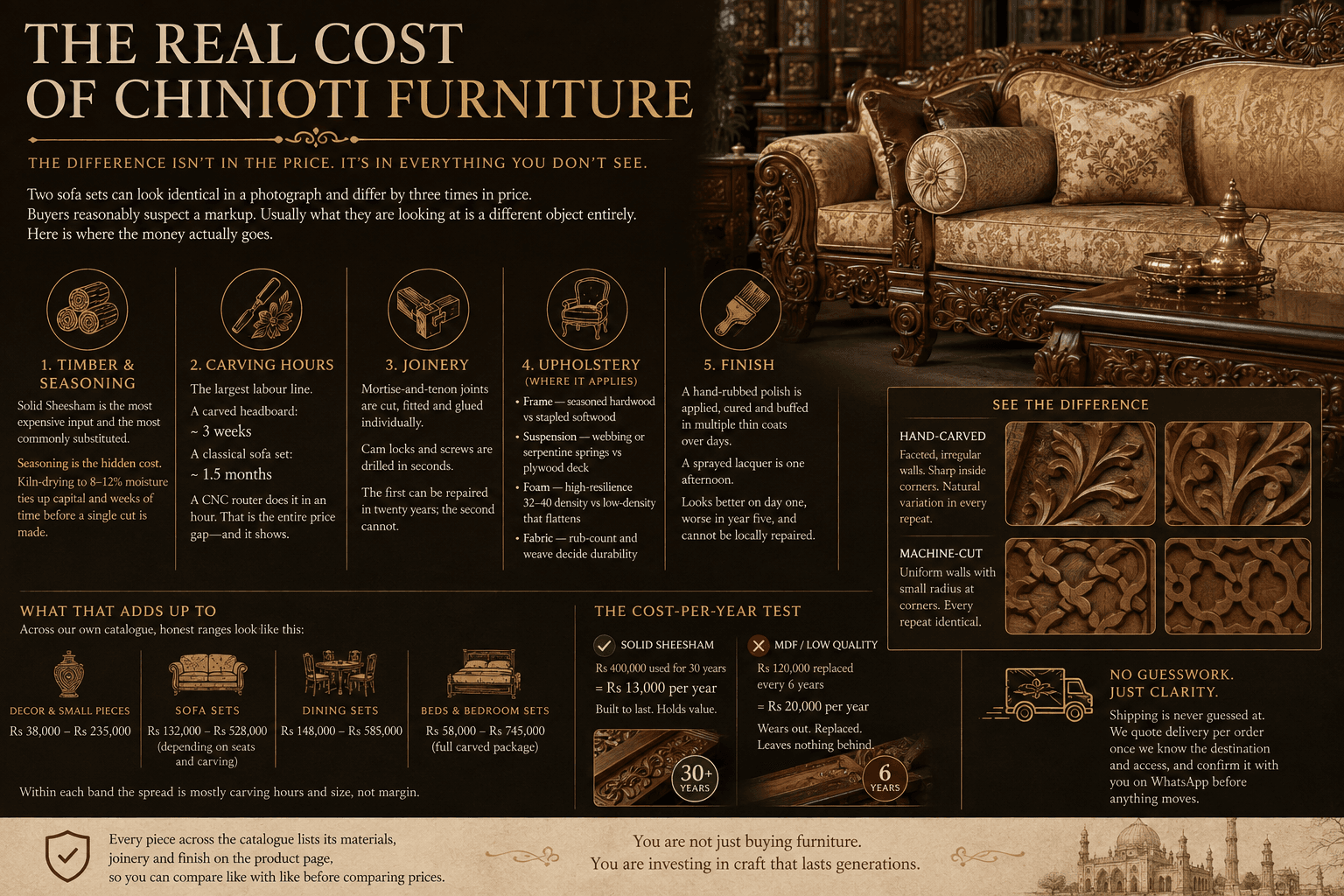
Why Made-to-Order Furniture Costs What It Does
A breakdown of where the money goes in a hand-carved Sheesham piece — timber, seasoning, carving hours, joinery and finish — and why the cheap version is not the same thing.