Buying Guides
How to Choose a Dining Table Size: A Room-by-Room Guide
The clearance numbers, seat widths and table shapes that decide whether a six-seater actually fits your dining room — with measurements you can check tonight.
By Chiniot Furniture Galleria · · 3 min read
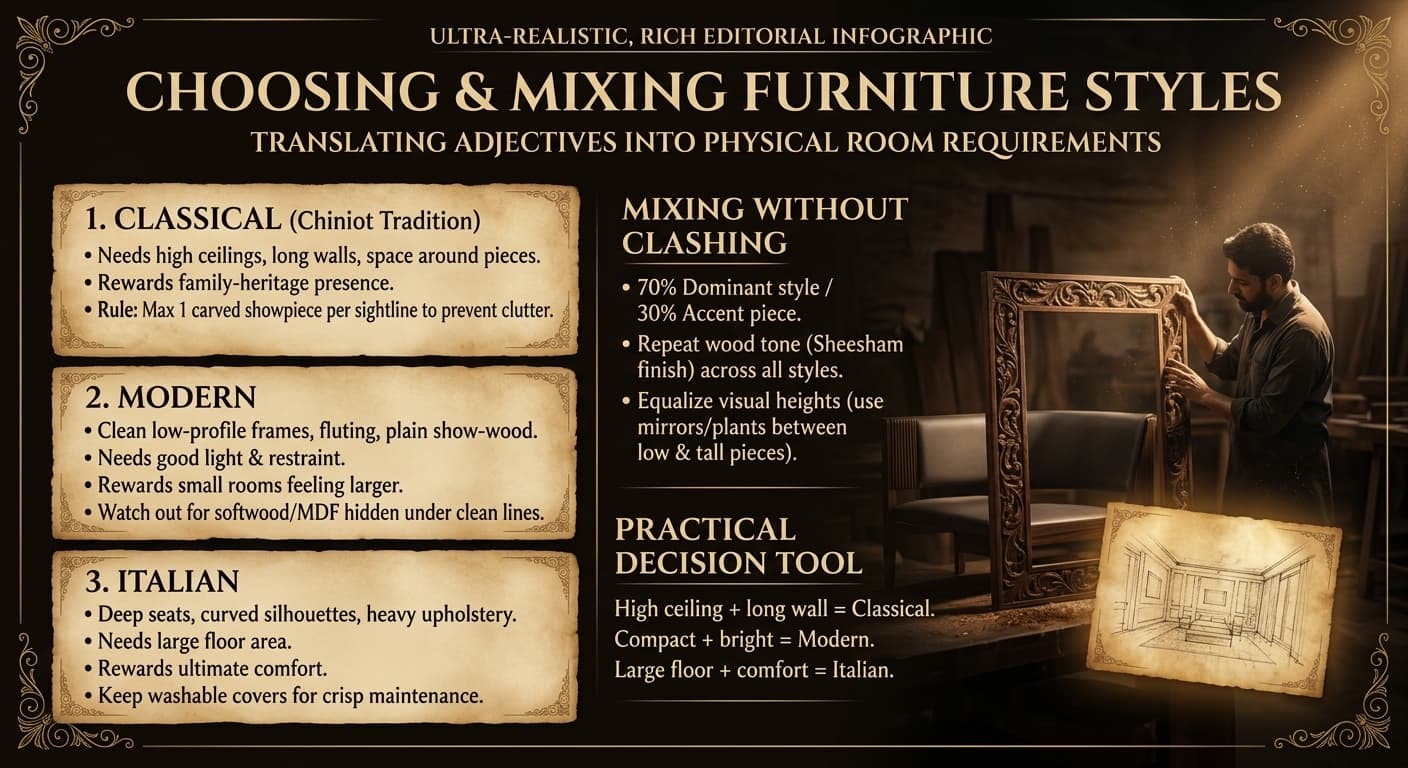
The most expensive furniture mistake is not the wrong style. It is the right table at the wrong size — a ten-seater in a room that cannot pull the chairs out, or a four-seater adrift in a hall. Both are avoidable with a tape measure and ten minutes.
Start with clearance, not with the table
Work backwards. A dining room needs 90 cm of clear floor on every side of the table for a chair to be pushed back and a person to stand. Where people walk behind seated diners, make it 105 cm.
So the largest table your room can take is:
- Room width minus 180 cm = maximum table width
- Room length minus 180 cm = maximum table length
A 3.6 by 4.5 m dining room therefore tops out around 180 by 270 cm — a comfortable eight-seater. Push past that and you get a room where the chairs hit the wall.
Seats per length
Allow 60 cm of table edge per person — a place setting plus elbow room.
- Four seats — 120 cm long, two per side
- Six seats — 180 cm, the Pakistani default
- Eight seats — 240 cm, three per side plus one at each end
- Ten seats — 300 cm, and a genuinely large room
Table depth should be 90 to 105 cm. Below 90 cm two facing place settings collide in the middle; above 105 cm the serving dishes in the centre become hard to reach.
Round, square or rectangular
- Rectangular — the most seats per square metre and the natural fit for a long room. Every
classical Chinioti dining set is built this way.
- Round — better conversation, no head of the table, and easier to walk around in a tight room.
A 120 cm round seats four comfortably; a 150 cm round seats six.
- Square — excellent for four in a square room, awkward beyond that, because a square that seats
eight is too wide to pass a dish across.
Height, and the chair relationship
Standard dining height is 75 cm. Seat height should be 45 cm, giving roughly 30 cm of leg clearance. Carved aprons and heavy stretchers eat into that: if a table has a deep decorative apron, check that your chair arms clear it before you commit. This is the first reason a chair set and a table bought from two different makers fail to work together.
A note on extension leaves
Extension tables solve the six-most-days, twelve-at-Eid problem, but the leaf mechanism is a long-term weak point in a solid-wood table living in a humid climate. Our own preference is a correctly sized fixed table plus a pair of light nesting tables or a console that can be pressed into service — no mechanism to seize, nothing to store.
Before you order
- Tape the table footprint onto the floor with masking tape.
- Put your existing chairs at the tape and sit down. Push back fully.
- Walk the perimeter. If you turn sideways anywhere, go one size down.
- Measure your doorways and stairwell — a 240 cm top does not always make the turn.
Our dining sets list full width, depth and height on every product page, and every set is made to order, so a table can be built to your room rather than to a standard size. Send us your room dimensions on WhatsApp and we will tell you the largest table that actually works in it.
Frequently asked
- How much space do I need around a dining table?
- Allow 90 cm of clear floor on every side so chairs can pull back and people can stand, and 105 cm on any side where people walk behind seated diners.
- What size dining table seats six people?
- A rectangular table about 180 cm long by 90 to 105 cm deep seats six comfortably at 60 cm of table edge per person. A 150 cm round table also seats six.
- What is the standard dining table height?
- Dining tables are built 75 cm high with chair seats at 45 cm, leaving about 30 cm of leg clearance. Check that a carved apron does not reduce that clearance below the height of your chair arms.
Keep reading
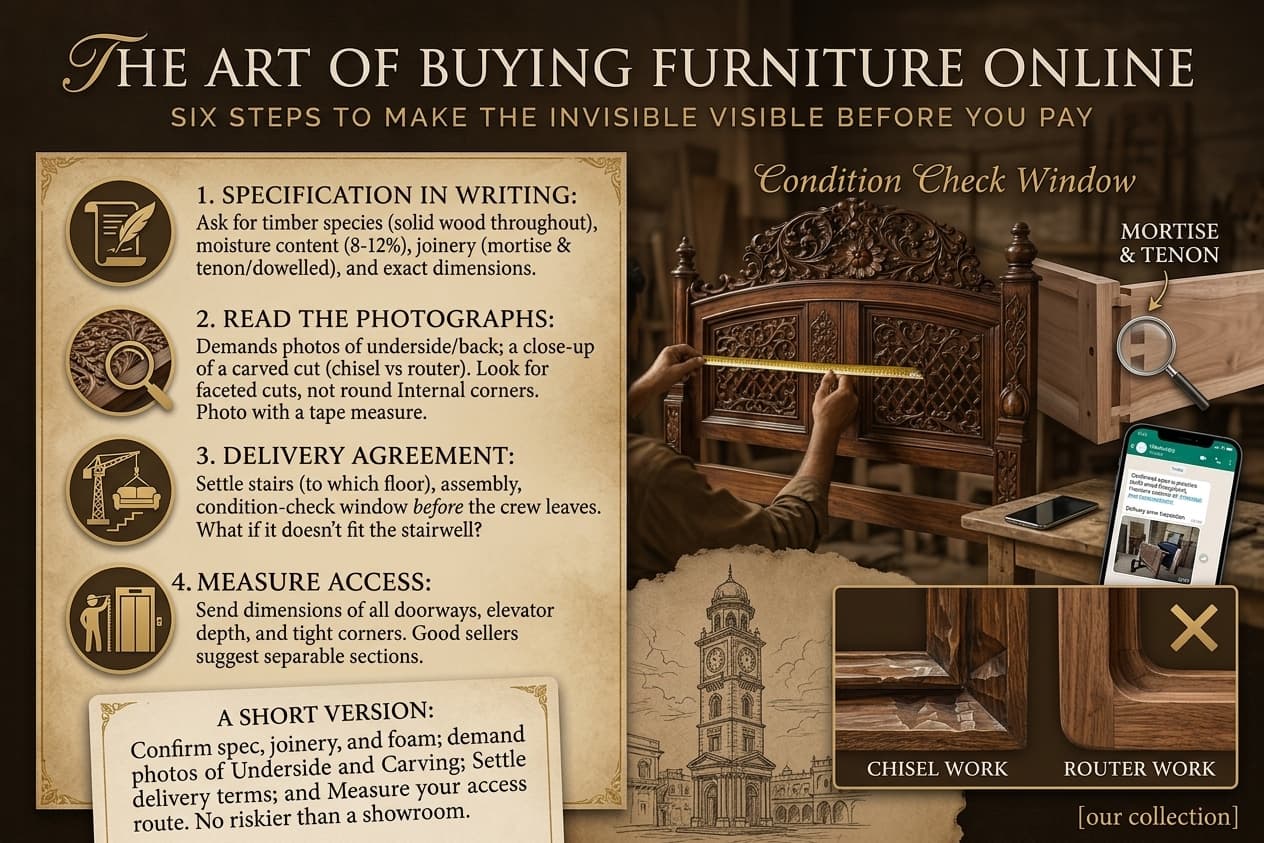
Buying Furniture Online in Pakistan: A Safe Ordering Checklist
How to judge a furniture seller you cannot visit — the questions to ask, the specifications to demand in writing, and the delivery details to settle before you commit.
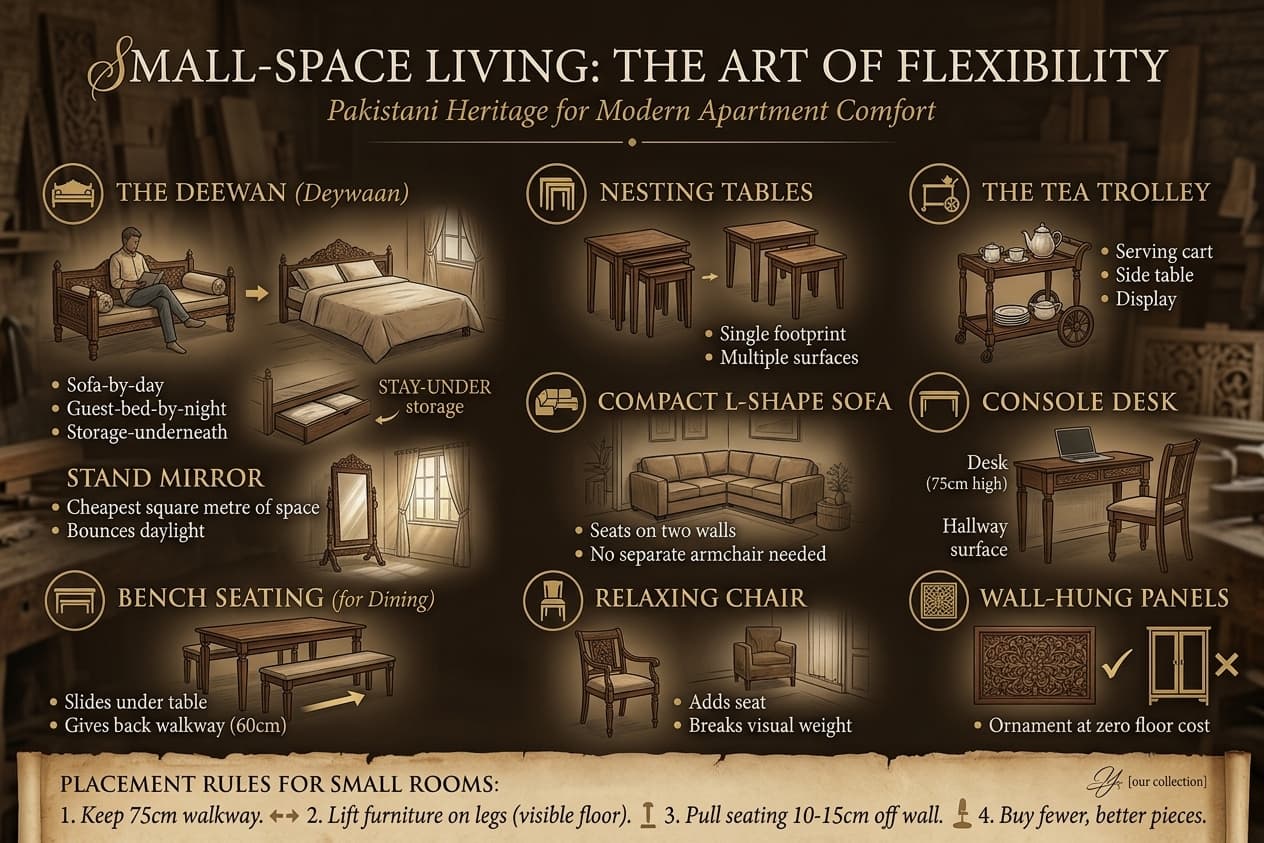
Furnishing a Small Apartment: Nine Pieces That Do Two Jobs
Nesting tables, deewans, tea trolleys and stand mirrors — the traditional pieces that solve modern apartment problems, and how to place them.
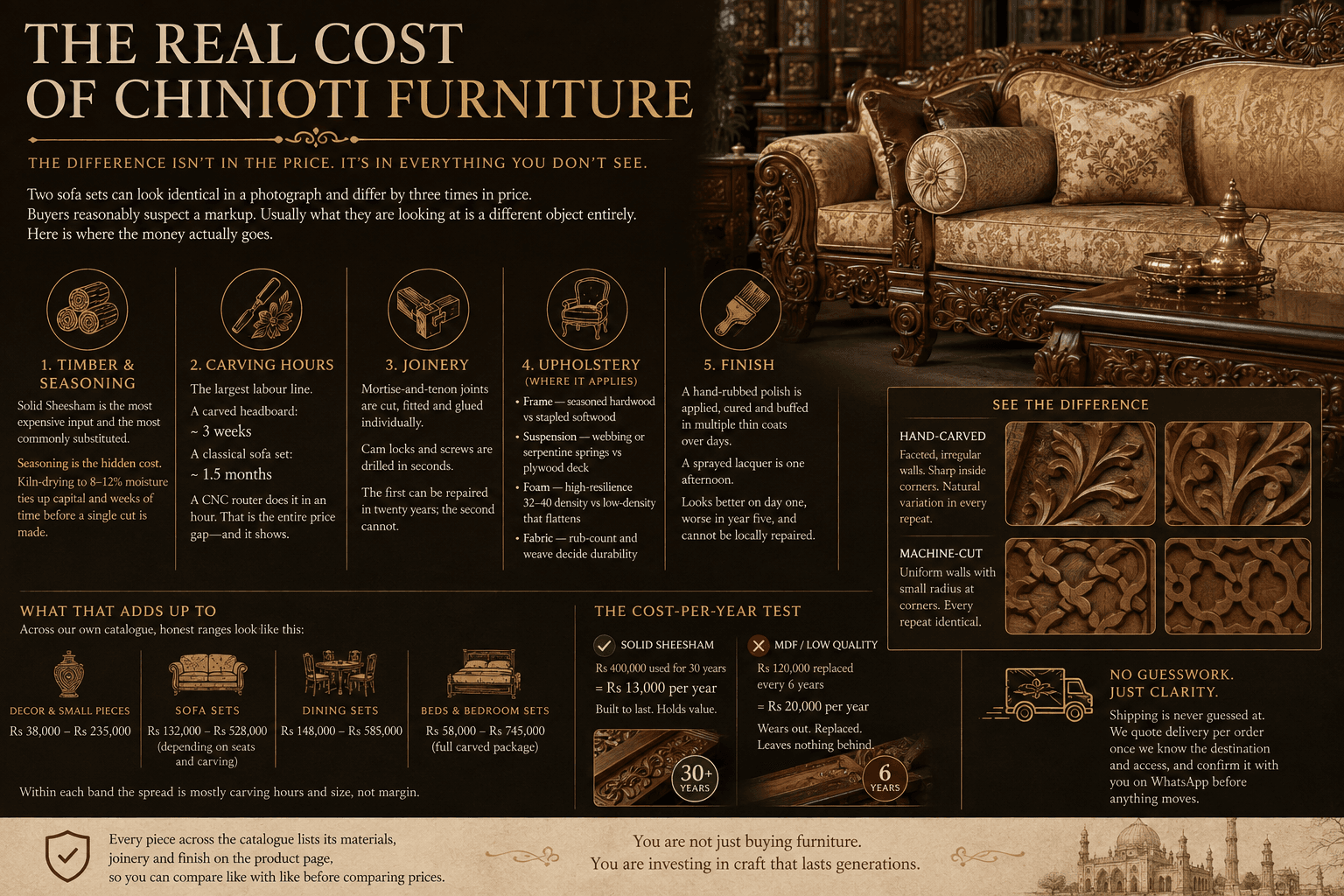
Why Made-to-Order Furniture Costs What It Does
A breakdown of where the money goes in a hand-carved Sheesham piece — timber, seasoning, carving hours, joinery and finish — and why the cheap version is not the same thing.