Buying Guides
L-Shape Sofa Buying Guide for Small Pakistani Lounges
Chaise orientation, seat depth, wall clearance and the two measurements people forget — how to fit a sectional into a lounge without blocking it.
By Chiniot Furniture Galleria · · 3 min read
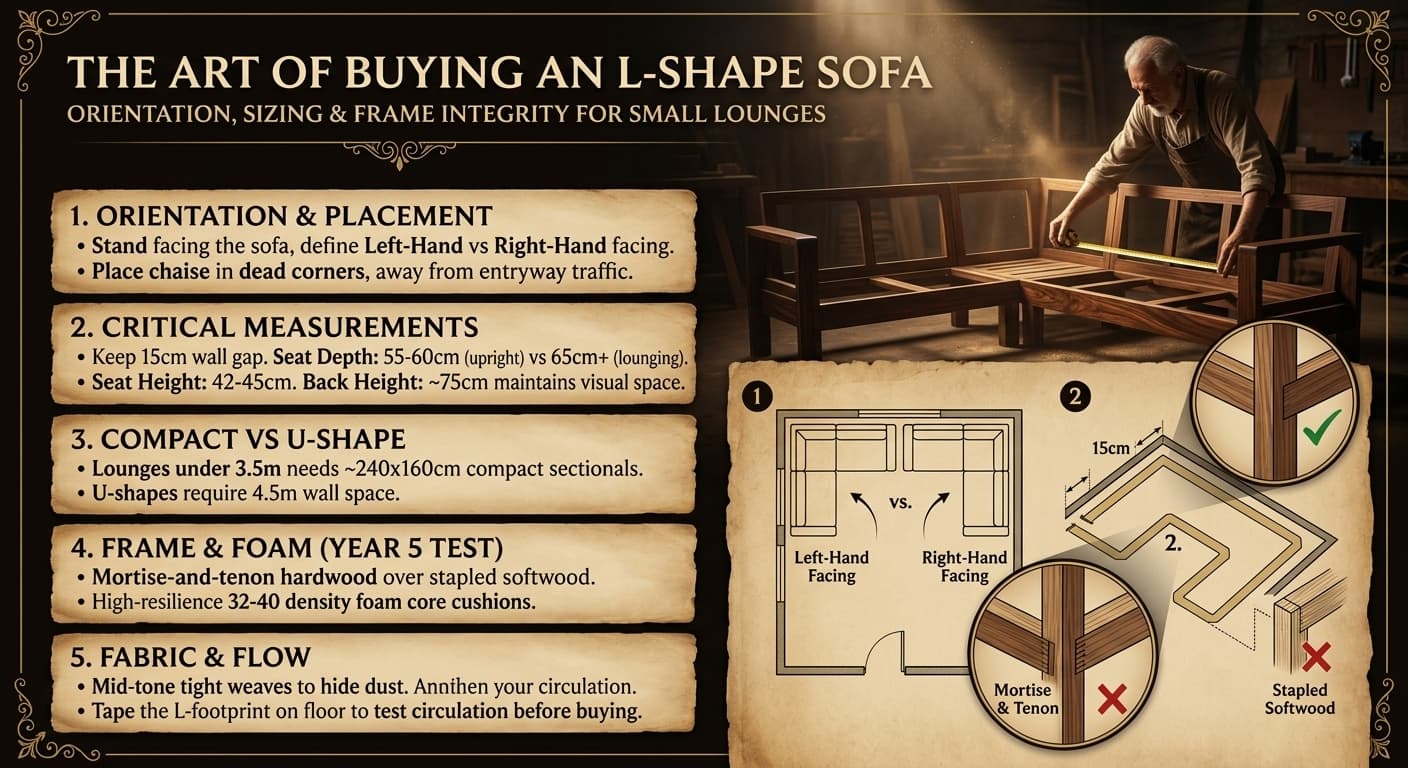
An L-shape sofa is the highest-value seating you can buy for a small lounge: it puts seats along two walls, kills the awkward corner, and removes the need for a separate armchair. It is also the easiest sofa to get wrong, because the chaise has to be on the correct side and there is no fixing that after delivery.
Left-hand or right-hand facing
The convention is to stand in the room facing the sofa. If the long chaise extends to your left, it is left-hand facing. To your right, right-hand facing. Half the confusion in this category comes from sellers who quote it from the seated position instead — so confirm which way the maker means.
Decide with two questions:
- Which corner of the room is dead space today? The chaise goes there.
- Where is the door? The chaise should never be the first thing you walk into — it turns the
entrance into a squeeze.
The measurements that matter
- Overall length and return — the two outer arms of the L. Both want 15 cm of breathing room
from the wall so the sofa is not jammed against it.
- Seat depth — 55 to 60 cm is upright and easy to rise from; 65 cm and above is a lounging depth
that suits taller people and makes shorter people perch.
- Seat height — 42 to 45 cm. Below 40 cm feels low and is harder for older family members.
- Back height — a low back near 75 cm keeps a small room visually open; 95 cm and above supports
your head but walls the room off.
- Doorway and stair clearance — the number everyone forgets. A one-piece L-shape frame often
cannot make a stairwell turn. Ask whether the sofa ships as separable sections.
Compact L-shapes genuinely work
If your lounge is under 3.5 m on its shorter wall, look at a compact sectional of roughly 240 by 160 cm rather than a full-size one. Our Ravi compact L-shape is built for exactly that room and the Mehran steps up for a standard lounge. A U-shape sectional needs about 4.5 m of clear wall and rarely belongs in an apartment.
Frame and fill: the part that decides year five
The upholstery is what you see; the frame is what you keep. A seasoned hardwood frame with mortise-and-tenon joints will outlive three fabric changes. A stapled softwood frame develops a creak within two years and cannot be reupholstered economically.
For the cushions:
- High-resilience foam, 32 to 40 density — holds its shape, the right default for daily seating
- Foam core with a fibre wrap — softer look, needs plumping, slower to flatten than pure fibre
- Pure fibre or low-density foam — cheapest, and visibly flat within a year of real use
Ask what the frame timber is and what the foam density is. If a seller cannot tell you both numbers, the answers are not good ones.
Fabric for a dusty climate
Dust is the constant here, not spills. A tight-weave fabric in a mid tone hides dust between cleans far better than a dark solid, which shows every particle, or a pale solid, which shows every mark. Removable, washable seat covers are worth more in practice than any factory stain treatment.
Before you order
Tape the full L footprint on the floor, including the 15 cm wall gap, and live with it for a day. Walk the route from the door to the far seat. If you brush the corner, size down — a sofa that fits the room but blocks its circulation is still the wrong sofa.
Browse the full sofa collection. Every listing carries frame material, seat depth and overall dimensions, and each set is made to order in the orientation you need.
Frequently asked
- How do I know if I need a left or right facing L-shape sofa?
- Stand in the room facing where the sofa will go. If the long chaise should extend to your left it is left-hand facing; to your right it is right-hand facing. Put the chaise in the corner that is dead space today, never directly in front of the door.
- What is the smallest L-shape sofa that still seats a family?
- A compact sectional of roughly 240 by 160 cm seats four to five and suits lounges with a short wall under 3.5 m. Full-size L-shapes want about 4 m, and U-shape sectionals need 4.5 m or more of clear wall.
- What foam density should a sofa seat use?
- High-resilience foam in the 32 to 40 density range holds its shape under daily use. Low-density foam and pure fibre fills look identical on delivery but visibly flatten within about a year.
Keep reading

Buying Furniture Online in Pakistan: A Safe Ordering Checklist
How to judge a furniture seller you cannot visit — the questions to ask, the specifications to demand in writing, and the delivery details to settle before you commit.
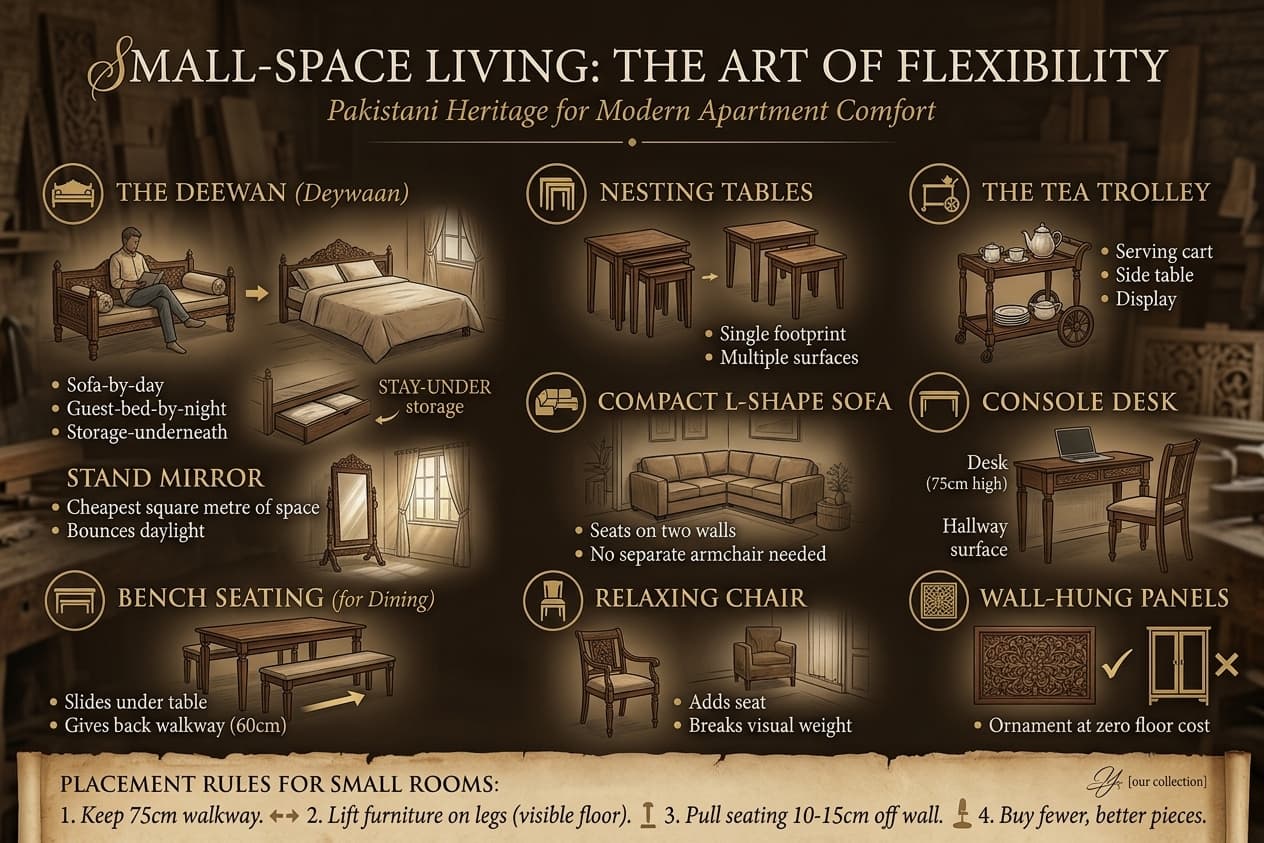
Furnishing a Small Apartment: Nine Pieces That Do Two Jobs
Nesting tables, deewans, tea trolleys and stand mirrors — the traditional pieces that solve modern apartment problems, and how to place them.

Why Made-to-Order Furniture Costs What It Does
A breakdown of where the money goes in a hand-carved Sheesham piece — timber, seasoning, carving hours, joinery and finish — and why the cheap version is not the same thing.