Buying Guides
Sheesham vs Mango, Acacia and MDF: Which Wood Should Your Furniture Be Made Of?
A plain-language comparison of the woods sold as solid furniture in Pakistan — how to tell Sheesham from mango, acacia and veneered MDF before you pay for it.
By Chiniot Furniture Galleria · · 3 min read
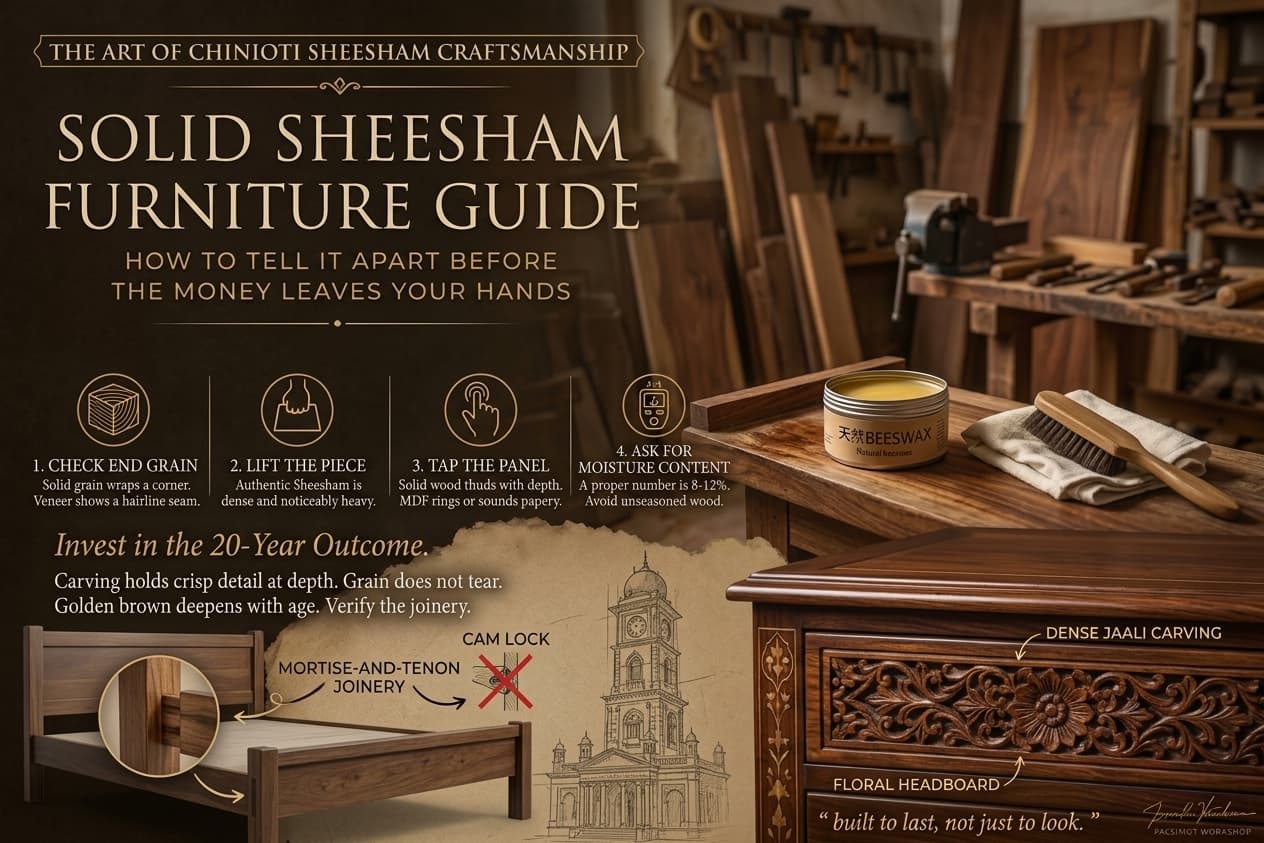
Almost every furniture showroom in Pakistan will tell you a piece is "solid wood". That sentence is doing a lot of work. Solid mango, solid acacia and solid Sheesham behave very differently over twenty years, and a veneered MDF carcass can look identical to all three on delivery day. Here is how to tell them apart before the money leaves your hands.
Sheesham, the Chiniot standard
Sheesham — Dalbergia sissoo, also sold as Indian rosewood or tali — is the timber Chiniot built its reputation on. It is dense, roughly 750 to 850 kg per cubic metre when seasoned, with interlocked grain that holds a carved edge instead of crumbling along it. That density is the whole reason a jaali lattice or a deep floral headboard is possible at all.
- Hardness — resists denting from chair legs, cutlery and children
- Carving — holds crisp detail at depth; the grain does not tear on a cross-cut
- Colour — golden brown to deep chocolate, with darker streaks that deepen with age
- Movement — very stable once properly kiln-seasoned, which is the critical caveat
Unseasoned Sheesham is the single most common cause of furniture failure in Pakistan. The wood is excellent; the drying is where corners get cut.
Mango wood
Mango is cheap, plentiful and genuinely solid. It is also softer, lighter in colour and far more prone to dents and to fungal staining in humid weather. It is a reasonable choice for a guest-room side table and a poor one for a dining table that will take daily use for a decade.
Acacia and other local hardwoods
Acacia — kikar — is hard, sometimes harder than Sheesham, but it moves more with humidity and is difficult to carve cleanly. You will see it in chunky, low-ornament pieces where its tendency to check and twist is less visible.
Veneered MDF and engineered wood
MDF is compressed fibre with a thin printed or wood veneer face. It is dimensionally perfect, takes a flawless factory finish, and costs a fraction of solid timber. It is also unrepairable: once an edge chips or the panel meets standing water, there is no sanding it back. Most modern-look bedroom sets under a lakh in Pakistan are MDF with solid trim.
Five checks to run in the showroom
- Look at the end grain. Solid timber shows continuous grain wrapping a corner. Veneer shows a
hairline seam where the face sheet stops.
- Lift one corner. Sheesham is noticeably heavy. If a solid Sheesham bed frame moves easily, it
is not solid Sheesham.
- Tap the panel. Solid wood thuds. MDF and hollow-core panels ring or sound papery.
- Ask for the moisture content. A workshop that seasons properly answers with a number — 8 to
12 percent is the range you want for Punjab. A workshop that does not season changes the subject.
- Check the joinery. Mortise-and-tenon or dowelled joints mean solid-wood construction. Cam
locks and screw-in fittings mean panel construction.
What this means for price
Solid Sheesham costs more per cubic foot than any of the alternatives, and hand-carving adds weeks of skilled labour on top of the timber. That is why a carved Chinioti bed set sits in the Rs 350,000 to Rs 750,000 band while a visually similar MDF set can be advertised at a quarter of it. You are not paying for the look — the look is copyable. You are paying for the twenty-year outcome.
Every piece in our bedroom collection and dining collection is kiln-seasoned solid Sheesham throughout, with no veneer or MDF in the carcass. Where a piece uses another material anywhere, its product page says so.
Frequently asked
- Is Sheesham the same as rosewood?
- Sheesham (Dalbergia sissoo) belongs to the rosewood family and is commonly sold as Indian rosewood. It is not the same species as Brazilian or East Indian rosewood, but it shares the density, colour depth and carving behaviour that make rosewood desirable.
- How can I tell solid wood from veneered MDF in a showroom?
- Check the end grain at a corner for a continuous wrap rather than a hairline seam, tap the panel and listen for a solid thud instead of a hollow ring, and lift one corner — solid Sheesham is distinctly heavy for its size.
- Does Sheesham furniture crack in Pakistani weather?
- Properly kiln-seasoned Sheesham at 8 to 12 percent moisture content is stable through Punjab summers and winters. Cracking and joint failure almost always trace back to unseasoned or air-dried-only timber, not to the species.
Keep reading

Buying Furniture Online in Pakistan: A Safe Ordering Checklist
How to judge a furniture seller you cannot visit — the questions to ask, the specifications to demand in writing, and the delivery details to settle before you commit.
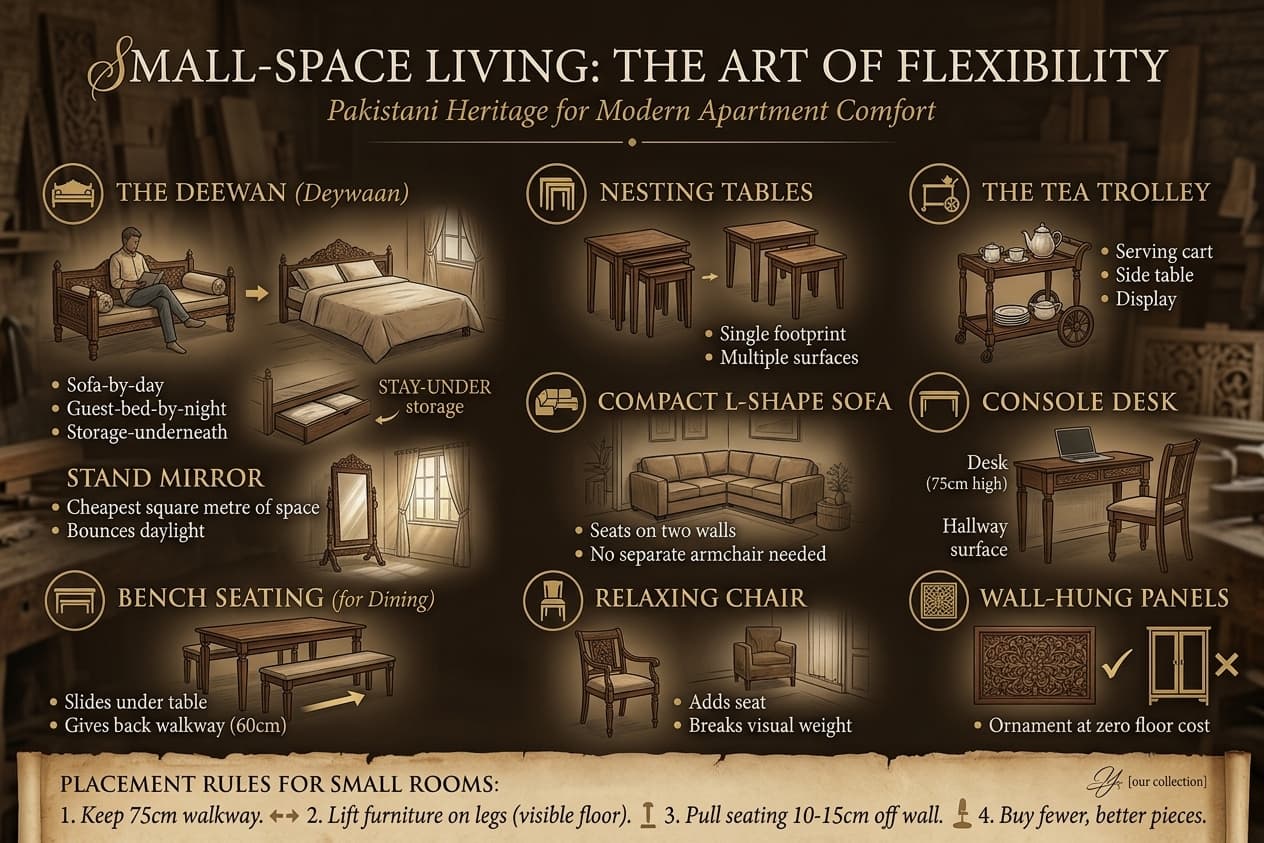
Furnishing a Small Apartment: Nine Pieces That Do Two Jobs
Nesting tables, deewans, tea trolleys and stand mirrors — the traditional pieces that solve modern apartment problems, and how to place them.
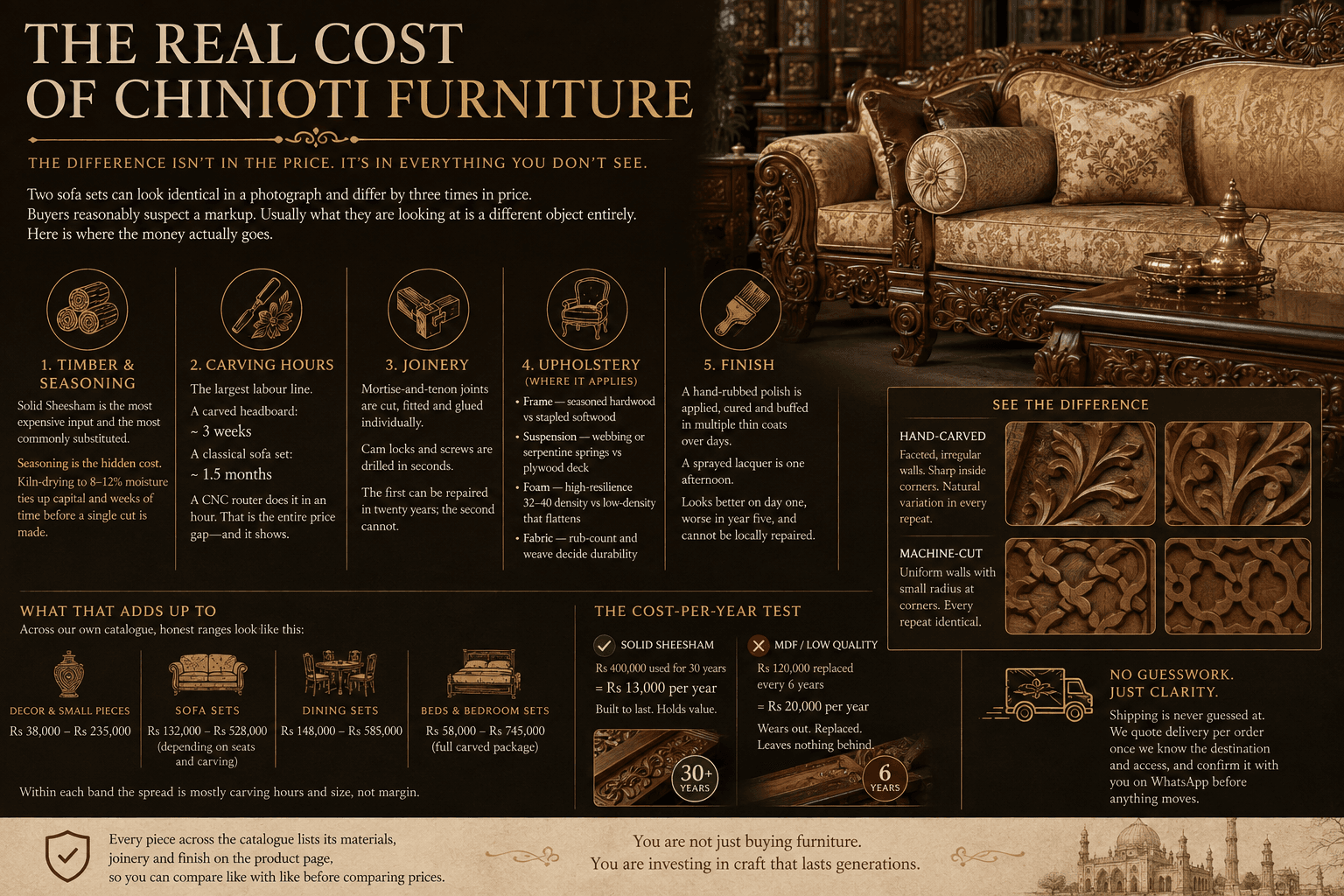
Why Made-to-Order Furniture Costs What It Does
A breakdown of where the money goes in a hand-carved Sheesham piece — timber, seasoning, carving hours, joinery and finish — and why the cheap version is not the same thing.